
Spotlight On: The City of Highland

With sustainability gaining steam as a key goal for St. Louis area municipalities, the Clean Air Partnership continues to use our blog to highlight some of the incredible eco-friendly initiatives underway in several cities across the region. These efforts are not only improving the environment, but also helping to reduce air pollution in the region. This month, we’re shining a spotlight on the City of Highland.

city-of-highland-logo

During the 7th annual Green Business Challenge Awards ceremony, held in early December, the City of Highland received recognition for its many efforts to become more environmentally friendly, which includes the recent introduction of “No Idling” signage in front of city facilities. The idea to create “No Idling” zones was born as part of the City of Highland’s involvement in the St. Louis Green Business Challenge.

The Challenge is a joint program of the St. Louis Regional Chamber and the Missouri Botanical Garden that helps businesses of all types and sizes to integrate “Triple Bottom Line” (fiscal, social and environmental) measures into the kinds of daily operations common to every business. Participants identify and adopt strategies that improve financial performance and engage employees in voluntary measures to reduce environmental impacts. The City of Highland saw “No Idling” zones as a way to reduce emissions and its carbon footprint. Since introducing the zones at city facilities, the City now has plans to extend its efforts to schools and businesses.

Additional municipal accomplishments made by the City of Highland have included the enactment of a leaf-burning ordinance, the establishment of a community recycling policy for curbside recycling and department practices, the institution of a Complete Streets Policy and the installation of LED lighting throughout the community. Highland has also been recognized as a Tree City USA community for 27 consecutive years. Cities achieving Tree City USA status are required to have an ordinance for 2012-arbor-day-012maintaining and enhancing community forests.

In recent months, Highland has also created an opportunity for children to interact with nature through the creation of a mini-ecosystem at the City’s Silver Lake Park. With the support of Madison County, the City of Highland continues to build on its accomplishments to further its work in sustainability and ultimately improve the quality of the air we breathe.
To learn more about the link between sustainability and air quality, explore our website, like us on Facebook or follow us on Twitter at @gatewaycleanair. For more information on the sustainable efforts underway in Highland, check out the St. Louis Green Business Challenge website at http://stlouisgreenchallenge.com/.
The environmental impact of the holiday season

It’s hard to believe, but another holiday season is upon us. As we decorate our homes, plan celebrations with family and friends and exchange gifts, our impact on the environment isn’t often top of mind. Unfortunately, what’s often considered “the most wonderful time of the year,” isn’t so wonderful for the environment. Consider the following:

  • 8,000 tons of wrapping paper are used during the holidays each year, equating to roughly 50,000 trees.
  • The 2.65 billion holiday cards sold each year in the U.S. could fill a football field 10 stories high.
  • Household waste increases by more than 25% from Thanksgiving to New Year’s.
  • Added food waste, shopping bags, packaging, wrapping paper, bows and ribbons add up to an additional 1 million tons of trash going into landfills each week.
  • On average, food travels 1,500 miles from farm to plate.

These statistics are shocking, but thankfully, there are numerous steps we can all take to celebrate in a greener way this holiday season. Below are some ideas that can reduce environmental impact.

  • Drive less. If each family reduced holiday gasoline consumption by one gallon, or opted to drive 20 miles less, greenhouse gas emissions could be reduced by one million tons.
  • Reduce energy use by purchasing LED holiday lights. LED bulbs use up to 95% less energy than traditional holiday lighting.
  • Opt for ground shipping for online purchases. Ground shipping uses less fuel than air transport.
  • Recycle wrapping paper. Each ton of mixed paper that is recycled can save the energy equivalent of 185 gallons of gasoline.
  • Avoid accumulating plastic shopping bags by leaving canvas or paper bags in your car to use on shopping trips.
  • Send e-cards or recycled cards.
  • Decorate with natural, biodegradable items like cranberries, popcorn and live flowers and greenery.
  • Look for holiday tree composting drop-off locations in your neighborhood.
  • Cut back on waste by utilizing reusable glassware, flatware, dishware table coverings and napkins.
  • Provide containers for recycling aluminum and glass beverage bottles and cans.
  • Serve organic or locally grown foods and prepare only as much food as needed.

Explore our website for information on ways to live greener year-round and for additional steps you can take to help improve air quality. We also encourage you to like us on Facebook or follow us on Twitter @gatewaycleanair.

Source:

25 Holiday Facts

Spotlight On: The City of St. Peters

With sustainability gaining steam as a key goal for St. Louis area municipalities, the Clean Air Partnership will be using our blog to highlight some of the incredible eco-friendly initiatives underway in several cities across the region that are not only improving the environment, but also helping to reduce air pollution in the region. This month, we’re kicking things off with a spotlight on the City of St. Peters.

 
In 2012, St. Peters became the first municipality to participate in the St. Louis Green Business Challenge. The Challenge is a joint program of the St. Louis Regional Chamber and the Missouri Botanical Garden that helps businesses of all types and sizes to integrate “Triple Bottom Line” (fiscal, social and environmental) measures into the kinds of daily operations common to every business. Participants identify and adopt strategies that improve financial performance and engage employees in voluntary measures to reduce environmental impacts.

 
In 2015, when the program launched a pilot “Green Cities Challenge” in 2015, to address the unique needs of local government business operations, the City of St. Peters engaged in a significant mentoring relationship with the City of St. Charles to help the community achieve its sustainable goals. As part of the mentorship process, the city worked with a menu of basic sustainability policies and practices, including measures defined by OneSTL, the regional plan for sustainable development. Sustainability leaders for St. Peters were able to assist the new St. Charles Green Team as they accomplished their selected Green Cities goals.

 
Participating in the Green Business Challenge at the rigorous Champion level, the City of St. Peters’ achievements included involving Recycling Ambassadors in its “Sunset Fridays” summer concert events. These volunteers educated the public while helping to recycle 151 pounds of cans and bottles. The City also hosted a “Clean Streams Day,” in which volunteers helped clean over 6,400 pounds of litter from area streams, and also implemented a “Shred It and Forget It” initiative, in which residents dropped off over 25,500 pounds of documents for shredding and recycling. Recent sustainable innovations in the City of St. Peters include placing recycling trucks on the roads; enacting a city office junk mail reduction initiative and developing the “No Ifs, Ands or Butts” campaign to encourage individuals to properly dispose of their cigarette butts.

 
In addition to helping reduce waste, the efforts made by the City of St. Peters are having a positive impact on air quality and helping to improve lung health in the region by reducing the emissions created during resources extraction, manufacturing and disposal.

 
Today, the City of St. Peters continues its sustainability commitment though advanced work in the St. Louis Green Business Challenge and as a mentor to both company and municipality Challenge participants. The City’s support for other municipalities, in both Missouri and Illinois, is especially valuable, as it provides them with experience-based insights to assist community leaders in advancing their own sustainable goals.

 
On Dec. 2, the City of St. Peters and other 2016 St. Louis Green Business Challenge participants will be recognized for their efforts as part of the 7th annual Green Business Challenge Awards ceremony. For information on the event, or to learn more about getting your municipality or company involved in the St. Louis Green Business Challenge/Green Cities Challenge, visit www.stlouisgreenchallenge.com.

 
To learn more about the link between sustainability and air quality, explore our website, like us on Facebook or follow us on Twitter at @gatewaycleanair.

Vehicle idling: Myth vs. Fact

As cooler, fall temperatures begin to settle into the region, you may be tempted to idle your vehicle more often than usual. Idling is one of the main contributors to air pollution, yet many misconceptions exist regarding the need to idle and the negative effects of idling on our air, our engines and our pocketbooks. Before you think about warming your car on a cold morning, or idling in a drive-thru or school drop-off zone on a chilly winter afternoon, make sure you can decipher what’s myth and what’s fact when it comes to vehicle idling.

Myth: Engines should be warmed up before driving, especially in cold weather.

Fact: Today’s electronic engines do not need long warm-ups, even in winter. No more than 30 seconds of warm-up time is needed in the winter. Easing into a drive is the best way to get a vehicle heating system to deliver warmer air faster.

Myth: Idling is good for your engine.

Fact: Excessive idling can damage your engine components, including cylinders, spark plugs and exhaust systems.  Fuel is only partially combusted when idling because an engine does not operate at its peak temperature. This leads to the build-up of fuel residues on cylinder walls that can damage engine components and increase fuel consumption.

Myth: It’s better to leave the engine running than shutting it off and restarting it because “cold starts” are hard on the engine and use more gas.

Fact: Frequent restarting has little impact on engine components.  Idling, however, forces an engine to operate in an inefficient and gasoline-rich mode that can affect the engine’s performance and reduce gas mileage. More than ten seconds of idling uses more fuel than restarting the engine.

Myth: It’s better to leave an engine idling because “cold starts” produce more pollution.

Fact: Driving a car immediately after a cold start allows the engine to heat up significantly faster, especially in newer models. When the car heats faster, its catalytic converter becomes more efficient at reducing emissions — by as much as 99 percent.

Explore our website for information on anti-idling initiatives, or additional steps you can take to help improve air quality. We also encourage you to like us on Facebook or follow us on Twitter @gatewaycleanair.

Air pollution brings increased risk for asthma attacks

For most kids, the start of the school year is an exciting time, filled with fun, friends and new adventures. But for kids with asthma, the new school year can come with serious health challenges.
This is because the trip back to class often brings with it a variety of asthma triggers that may lead to asthma attacks. These triggers can include emotional stress and anxiety, new sports routines and indoor and outdoor allergens.

 
The amount of pollution in our air is a major contributor to asthma attacks. Exposure to smog is dangerous for kids, especially since they are still growing and generally spend more time outdoors than adults. Dirty air can interfere with lung development and increase the risk of lung infections in all children, and the health risks are far greater for children with asthma. Currently, approximately 6.3 million children suffer from asthma, and the condition ranks as one of the leading causes of missed school days.

 
Smog is formed when heat and sunlight react with pollution – much of which is released from vehicle tailpipes. Consider where your own children attend school. Is there a long line of parents idling their vehicles as they wait to drop off their children? Are there idling buses near the school entrance? All of those idling vehicles release emissions that are dangerous for children and can exacerbate asthma.
The good news is that since we are a part of the air pollution problem at school, we can also be a part of the solution. By simply making a commitment to refrain from idling on school grounds, we can help reduce the emissions that lead to poor air quality and ultimately help students breathe easier.


Area schools are also encouraged to get involved in the clean air effort by placing “no idle” signs in their drop-off lanes and parking lots. FREE signs are available to schools by contacting Susannah Fuchs with the Clean Air Partnership via email at [email protected]. To learn more, click here.

 
For information about additional steps you can take to help improve air quality, we encourage you to explore the tips page (link to page) of our website. We also encourage you to like us on Facebook or follow us on Twitter @gatewaycleanair.

Back to school tips for cleaner air

With the summer season over, children across the region are now settling into their back-to-school routines. If you’re one of the many parents who drive their children to school each day, now is a great time to consider other transportation options that can help reduce the emissions that lead to air pollution, while also helping to improve lung health across the St. Louis area.

The following tips can help make the school commute a more air quality-friendly one:

Walk or bike to class: For kids that live close to school, walking and biking are great commuting options that also offer an opportunity to get some exercise, whenever weather and air quality conditions are favorable.

Encourage the kids to ride the bus: For those who live near a school bus route, the bus can offer an eco-friendly way to get to class, especially as more districts purchase lower pollution buses.

Share the ride to school: If driving to school is the only option for getting there, work with neighbors to organize carpools to reduce emissions and also help parents and students save money on gas.

• Avoid unnecessary idling: Idling engines produce toxic pollution that is known to cause serious health concerns. Exposure to car exhaust can also aggravate asthma symptoms. And with asthma ranking as the most common chronic illness in children, vehicle idling can be especially harmful to kids. When dropping the kids off, avoid idling parking lots, bus and carpool lanes and delivery areas.

At back to school time, and year-round, parents and kids can access a wealth of air quality information and tips to help them do their share for cleaner air on the Clean Air Partnership website. Additional air quality tips and information can also be found on our Facebook page and on Twitter @gatewaycleanair.

The link between hot weather and ozone pollution

Over the last several weeks, the St. Louis area has seen its share of scorching temperatures and poor air quality. And as we head into what is traditionally the hottest part of summer, air quality conditions will have the potential to creep into the orange and red range. Have you ever wondered why scorching, hot days are often synonymous with poor air quality?

On summer days, heat and sunlight react with hydrocarbons and nitrogen oxides emitted by automobiles and other sources, which mix to form a ground-level layer of ozone, also known as smog. High amounts of ground-level ozone result in the orange and red air quality days that can pose health risks for all of us, especially children, the elderly and those with respiratory concerns.

When inhaled, even at very low levels, ozone can cause acute respiratory problems, aggravate asthma, result in a 14-20 percent decrease in lung capacity for healthy adults, cause inflammation of lung tissue, lead to increased hospital admissions and emergency room visits and impair the body’s immune system defenses, making more people susceptible to respiratory illnesses such as bronchitis and pneumonia.

The good news is that there are many simple steps we can all take to help reduce the emissions that lead to ozone formation and poor air quality. Since transportation choices have the most profound effect on air quality, efforts to carpool, vanpool, use the bus and MetroLink, telecommute or use flextime, and walk or bike more can go a long way toward improving air quality. Those that drive alone are encouraged to combine errands into a single trip, plan their route in advance to avoid idling in traffic tie-ups and construction zones and refrain from other forms of unnecessary idling.

  • Other emissions-reducing steps individuals can take on poor air quality days include:
  • Refueling gas tanks after dusk and not topping off the tank.
  • Avoiding the use of gas-powered lawn mowers and garden equipment, if possible, or mowing before 10 a.m. or after 7 p.m. to avoid peak ozone formation hours.
  • Using a gas grill instead of a charcoal when barbecuing.

Throughout the summer, area residents can view the daily air quality forecast on our homepage. Visitors can also sign up there to receive the daily forecast via email. The forecast and a wealth of air quality tips and information can also be found on our Facebook page and on Twitter @gatewaycleanair.

The positive impacts of idle reduction

Tailpipe w-emissionsHow often do you find yourself idling your car in drive-thrus, parking lots or right outside your child’s school? It’s probably a lot more than you care to admit, especially given how bad all of that unnecessary idling is for our air.

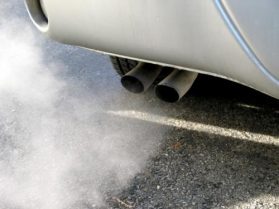
Idling vehicles emit 20 times more pollution than a car traveling at 30 mph. And the pollution released from vehicle idling includes air toxics, which are known to cause cancer, respiratory and reproductive issues, birth defects or other serious health concerns.

While you may not always be able to avoid idling, there are many instances when you can make the choice not to idle. These include:

  • Turning off your ignition when you have to wait for more than 10 seconds. Idling for just 10 seconds wastes more gas than restarting the engine.
  • Not “warming up” your vehicle. Modern engines don’t need more than a few seconds of idle time before they are safe to drive.
  • Planning your trips to avoid construction zones and traffic tie-ups. Resources like MoDOT’s Gateway Guide website at www.gatewayguide.com can alert you to high-traffic areas before you leave the house, allowing you to choose an alternate, idle-free route.

For every 10 minutes your engine is off, you’ll prevent one pound of carbon dioxide from being released into our air – helping individuals across the region breathe easier. And with statistics noting that 10 minutes of idling a day wastes 27 gallons of fuel a year, choosing not to idle is also a great way to save fuel and money.

Explore our website for information on anti-idling initiatives, or additional steps you can take to help improve air quality. We also encourage you to like us on Facebook or follow us on Twitter @gatewaycleanair.

The 411 on AQI

AQI 2

We’re all familiar with the weather forecast, but what about the air quality forecast? During the summer months, daily air quality forecast updates let the public know if it will be a green, yellow, orange or red air quality day – and each color means something different for our health. As the weather heats up and the risk for poor air quality accelerates, these forecasts can play an important role in helping individuals avoid the harmful effects of air pollution.

The colors represent values within the Air Quality Index (AQI), a numerical system that measures how clean or polluted the air is. The Environmental Protection Agency calculates the AQI for five major air pollutants as regulated by the Clean Air Act: ground-level ozone, particle pollution, carbon monoxide, sulfur dioxide and nitrogen dioxide. With values ranging from 0 to 500, the AQI determines health effects that may be experienced within hours or days after breathing polluted air. The higher the AQI value, the greater the level of air pollution and potential for concerns.

The AQI is divided into six categories, each corresponding to a different level of health concern. Symbolized by the color green, an AQI in the 0-50 range is considered “good,” and air pollution poses little to no health risk. When the AQI ranges from 51-100, the health concern level is “moderate” and symbolized by the color yellow. In this range, air quality conditions are acceptable; however, people who are unusually sensitive to ozone may experience respiratory symptoms.

When the AQI ranges from 101 to 150, air quality conditions are “unhealthy for sensitive groups” and symbolized by the color orange. People with lung disease, older adults and children are at a greater risk from exposure to ozone, while those with heart and lung disease, older adults and children are at greater risk from the presence of particles in the air. An AQI from 151 to 200 represents “unhealthy” air quality conditions and is symbolized by the color red. At this AQI, everyone may begin to experience some adverse health effects, and members of the sensitive groups may experience more serious effects. Any AQI from 201-500, is considered “very unhealthy” or “hazardous,” and can trigger negative health effects and health warnings for the entire population.

The health effects of poor air quality are numerous and can include shortness of breath, coughing, wheezing, headaches, nausea, eye and throat irritation and decreased lung function. Additional risks include aggravation of respiratory problems, asthma, allergies and lung diseases; impairment of the immune system, increased hospital and ER visits and irregular heartbeat, heart attacks and premature death in those with heart or lung disease.

To help keep the public updated on air quality conditions, the Clean Air Partnership posts the daily air quality forecast on our homepage. Residents can also visit the website to sign up to receive the forecast via email. Throughout the summer, the forecast can also be found on our Facebook page or by following the organization on Twitter @gatewaycleanair.

More poor air quality days likely this summer

Screen Shot 2016-05-17 at 4.28.59 PMThe American Lung Association’s 2016 State of the Air report ranked St. Louis as the 18th most polluted metropolitan area in the nation for ozone pollution, once again confirming what a critical concern air pollution continues to be locally. And those concerns have the potential to ramp up in the coming months, as the St. Louis area settles into its first summer season featuring stricter ozone standards.

Last October, in an effort to further protect public health, the Environmental Protection Agency strengthened the National Ambient Air Quality Standards for ground-level ozone to 70 parts per billion (ppb), down from 75 ppb. With these standards now in effect, the area has the potential to see many more orange and red poor air quality days this summer.

Luckily, there are a number of steps all of us can take to help reduce emissions, and keep air quality in the healthy range.

Since transportation has the most profound impact on air quality, making the choice to spend less time behind the wheel is an easy way to reduce the emissions that lead to poor air quality. Actions like using transit, carpooling and vanpooling, choosing not to idle your vehicle, combining errands into a single trip, walking and biking more, telecommuting and/or adjusting work hours to stay off the road during peak commute times all help take cars off area roads and the related emissions out of our air. These actions are especially critical when poor air quality conditions are in the forecast. In addition, there are many eco-friendly lifestyle changes that can further positively impact air quality, including efforts to conserve energy, recycle, reduce waste and reuse items.

Throughout the summer, area residents can view the daily air quality forecast on our homepage. Visitors can also sign up there to receive the daily forecast via email. The forecast can also be found on our Facebook page and on Twitter @gatewaycleanair.