The St. Louis Green Business Challenge remained a leader of sustainability in the St. Louis region last year by continuing to deliver Triple Bottom Line results (fiscal, social and environmental) to businesses of all types and sizes across the bi-state area. Like the Clean Air Partnership, the Challenge focuses on encouraging and inspiring voluntary steps to help improve the environment and air quality in the region, and we’re pleased to highlight efforts of green businesses such as Ameren Missouri that continue to take action for cleaner air by channeling their time and energy towards practicing sustainability.
A returning participant of the St. Louis Green Business Challenge, Ameren Missouri strives to ensure all customers – including the underserved and vulnerable – will benefit from their efforts. Growing energy efficiency programs to include more St. Louis homes and businesses of all sizes saves money, energy and brings the company closer to its net-zero carbon emissions goal, which is why the company elected to develop and report on their Champion Innovation Project – Leading the Way to a Sustainable Energy Future – during the 2021 Challenge.
To help reach their goal of net-zero carbon emissions by 2050, Ameren Missouri continued to make transformative steps by adding 700 MW of wind power last year and a water reduction goal targeting 95% reduction in withdrawn water for thermal generation. Currently, recycled water is used at several company facilities with 99% of water withdrawn being discharged back to the environment.
Additionally, through Ameren Missouri’s Community Savers® Program, property owners, community managers and income-eligible customers can receive energy-saving products for their home, along with rebates when they make eligible energy efficient upgrades. Since October 2020, Ameren Missouri residential customers have received 17,279 zero cost Sensi and Nest smart thermostats to help cut down on costs and to control their energy use, which also positively benefits the region’s air quality!
Other noteworthy initiatives include a new Sustainability Employee Resource Group (SERG), which hosted a three-talk biodiversity lunch ‘n’ learn series and a company-wide, virtual sustainability scavenger hunt. Moreover, Ameren Missouri supported the successful launch of the St. Louis Vehicle Electrification Rides for Senior (SiLVERS) EV Program with charging station construction incentives to continue electrification efforts in underserved communities.
Looking ahead to a sustainable energy future, Ameren Missouri also established a Supply Chain Sustainability Department that has already engaged 92 top suppliers to discuss increasing focus on sustainable action within the company’s supply chain, in addition to updating their Supplier Code of Conduct to continue formalizing the internalization and defining of Environmental, Social and Governance (ESG) topics.
For additional information on how your company can get involved in the St. Louis Green Business Challenge, subscribe to their weekly E-Newsletter or visit stlouisgreenchallenge.com. To learn more about the link between sustainability and air quality, explore the Clean Air Partnership website, like us on Facebook or follow us on Twitter at @gatewaycleanair.
While the coronavirus shut down Mardi Gras parades and carnivals in cities across the globe last year, the tradition is making its highly anticipated comeback for 2022 in St. Louis. Being home to one of the largest Mardi Gras celebrations outside of the Big Easy, the crown jewel of Soulard’s Mardi Gras season returns in just a few days, where revelers from far and wide will gather for the Grand Parade that begins at Busch Stadium and proceeds through the streets of Downtown South and Soulard, ending at Anheuser-Busch Brewery. And while green is one of the three prominent colors you’re guaranteed to see this weekend, the event is notoriously known for being anything but.
Thankfully, there are plenty of ways to incorporate sustainability into your favorite ‘Mardi Pardi’ plans, and you might even be surprised at how simple it can be to do so. By adopting just one of many possible eco-friendly actions, you can have a significant impact on improving the region’s air quality and helping people all over St. Louis breathe easier. That’s something everyone can celebrate!
For starters, to help eliminate multiple vehicles on the roads converging in Soulard, Metro is making it easy for riders to let the good times roll on Saturday, Feb. 26, while avoiding street closures, traffic tie-ups and the search for parking. MetroLink is a convenient option with the Stadium MetroLink Station located just a short walk from all the action. Individuals can also avoid parking headaches by leaving their vehicle at one of 20 free Park-Ride lots in Missouri and Illinois and riding MetroLink, with trains arriving and departing every 10 minutes at the Stadium Station and at all MetroLink stations between the Forest Park-DeBaliviere and Fairview Heights stations. Additionally, MetroBus is another great way to get to the celebration, with the #10 Gravois-Lindell, #30 Arsenal and #73 Carondelet MetroBus routes serving stops near Soulard. For real-time traffic updates to avoid delays and congestion on parade day, be sure to also check out MoDOT’s Gateway Guide at gatewayguide.com.
It wouldn’t be a proper Mardi Gras celebration without beads, but these popular accessories made up of cheap plastic strings and other toxic materials like polystyrene and lead also pose an unnecessary threat to the environment. Rather than littering the streets or tossing them into trash cans, consider disposing of your beads in a proper recycling container or, if you’re in tune with your crafty side, try reusing them in your next art project. Tons of trash in the form of non-biodegradable Styrofoam cups, aluminum cans and glass bottles also get left behind on parade day, which eventually wind up in landfills, so keep an eye out for recycling containers along the parade route to help reduce greenhouse gas emissions that lead to poor air quality.
Do your share for cleaner air by keeping green in your mind and not just your wardrobe this Mardi Gras. To learn more about the link between living greener and our air quality, visit our website at cleanair-stlouis.com, like us on Facebook or follow us on Twitter at @gatewaycleanair.
As we’ve rounded out another extraordinary year of highlighting the tremendous work that several local organizations and municipalities have put forth to help improve the environment and air quality in their communities, we’re pleased to recognize the green efforts of two final participants from the 2020 St. Louis Green Cities Challenge – Wentzville and Wildwood, MO.
With a strong commitment to the mission of the Green Cities Challenge, the City of Wentzville’s employee-led Green Team fosters sustainable practices citywide and encourages all employees to reduce their environmental footprints. Through quarterly meetings, projects such as pollinator plantings, holiday gift-bag exchanges, policy review and more, the city continues to be resourceful and environmentally responsible.
For starters, Wentzville’s Parks and Recreation staff swapped out the existing Holiday Night Light scene display for LED lights. Since starting this gradual change about three years ago, the city decreased overall power usage for the displays by an astounding 62%. An additional 12,000 bulbs will be changed out this year, converting nearly all the lightbulbs to LEDs. Since LED bulbs are up to 80% more efficient than traditional lighting and draw far less power, this reduces the demand from power plants and decreases greenhouse gas emissions, which also positively benefits the region’s air quality! Additionally, the city’s Employee Committee purchased reusable utensils for quarterly staff luncheons to prevent an estimated 1,000 plastic utensils from going to landfills each year.
To further reduce environmental impact, the city’s Stormwater Advisory Committee and Green Team completed a pollinator planting at the Schroeder Creek Boulevard – William Dierberg Drive roundabout. More than 700 native flowers were planted to help the local ecosystem and increase biodiversity. Moreover, the Green Team collaboratively built a sustainability-focused employee resource website with an assortment of eco-friendly offerings, including a “Green at Home” section with activities like composting, rain scaping and educational activities for kids; a “Recycling in the Office” section featuring the what’s, how’s and why’s of recycling; “A Green Guide” with tips on where and how to start your sustainable journey; and a calendar of sustainability-focused days, regional events and opportunities.
With Wildwood being one of the largest municipalities in Missouri and St. Louis County – in both population and land mass – the city has shown that it’s possible to develop businesses and build homes while protecting the beauty and space of its land. Among their impressive green innovations to receive recognition in the 2020 Challenge was a community planting project that installed at least 20 native trees and hundreds of native plants at LaCave Trailhead. The City of Wildwood also removed over 100 ash trees affected by the Emerald Ash Borer, an invasive jewel beetle that feeds on ash species, and replaced over 80 trees with Missouri native species using a Tree Resource Improvement and Maintenance (TRIM) grant. Last but not least, the city installed new and improved recycling bins with relevant labels in all City Hall meeting rooms to prevent contamination to recycling and promote proper waste disposal.
In the coming months, the Clean Air Partnership will continue to shine a spotlight on local clean air advocates and the latest St. Louis Green Business/Green Cities Challenge Class of 2021. For more information on how to get your company or municipality involved in this year’s Challenge, contact program manager Jean Ponzi at [email protected] or subscribe to the Challenge’s weekly E-newsletter here. And stay tuned for more information on registration for the 2022 Challenge, which officially opens on Feb. 21!
To learn more about the link between sustainability and air quality, be sure to check out our website, like us on Facebook or follow us on Twitter at @gatewaycleanair.
During the month of January, the “new year, new me” mentality is top of mind for many, with popular New Year’s resolutions focused on eating better, hitting the gym more, pursuing a career ambition or taking up a new hobby. While few people actually stick to extreme goals, we oftentimes overlook other aspects of daily life where simple changes can have a significant impact on our health and the planet.
Making the conscious choice to go green in 2022 and resolving to adopt some eco-friendly actions will result in multiple positive changes to your wallet, your well-being and the region’s air quality. You might even be surprised to learn how truly easy it can be to incorporate sustainability into your everyday routine. If you’re unsure where to begin, here are a few tips to consider for greening your resolutions for the year ahead:
Walk, Bike or Take Public Transit – Since transportation-related emissions have always been one of the biggest contributors to air pollution, the choices people make on how to get around considerably affect air quality and the health of the region. Actions like walking and biking instead of using a vehicle for short trips, taking public transportation or sharing the ride to work in a carpool or vanpool are all great ways to reduce harmful auto emissions to help keep the air quality in healthy ranges.
Green Your Home – When your appliances have reached the end of their useful lives, opt for new ones that are Energy Star® rated to maximize efficiency. Switching out incandescent light bulbs with LEDs, putting timers on lights and investing in smart power strips will also help to eliminate unnecessary electricity use. While reducing and reusing are the most effective ways to save money and resources, recycling is another vital piece of greening your home by helping to keep waste out of landfills and turning glass, paper, plastic and other items into new materials. Set up separate recycling bins in your home so it’s easy for all family members to participate and consider purchasing recycled products to help clean the air.
Nix Bottled Water – Did you know that up to 80 percent of single-use water bottles in the United States never get recycled? Not only does the production of plastic water bottles contribute significant amounts of greenhouse gases to the atmosphere, their litter lingers for years on end. Instead of buying single-use bottles when you’re out and about, consider buying a reusable water bottle you can take with you and refill as needed to cut down on unnecessary waste and help improve air quality.
Go Paperless When Possible – There are many places where you can opt out of paper – whether that be credit card bills, receipts or even your favorite household cleaning products. Paper towels, for example, may be useful and convenient but collectively contribute to deforestation and an ever-increasing waste problem. Microfiber cloths, cloth or cotton napkins are great alternatives to keep on hand for kitchen spills and messes that are also more sustainable and cost-effective. Signing up for online banking, opting for email versions of receipts, printing on both sides of a sheet or using the back side of old documents for scrap paper are also resourceful ways to reduce paper waste. This helps to save trees and cut back on air pollution and water consumption associated with producing and transporting paper.
Think Globally, Buy Locally – Locally grown food offers countless benefits and also helps to reduce environmental impact. Imported food is often shipped hundreds and sometimes even thousands of miles to arrive at the supermarket. The greater distance the food has to travel, the more fossil fuels are consumed. Buying local produce reduces the amount of travel time for big transport trucks, ultimately improving the air quality by cutting back on air pollution and greenhouse gas emissions.
For more great tips on how we can all work together to achieve cleaner air in 2022, visit our website, like us on Facebook or follow us on Twitter at @gatewaycleanair. Have a happy and healthy New Year!
As the St. Louis metro area continues to experience temperatures that have been warmer than usual for this time of year, the first day of winter is just days away, highlighting the importance of maintaining our environment and air quality. That’s why this month, we’re thrilled to shine a spotlight on Madison County Planning & Development for their noteworthy green achievements and innovations that are having a positive effect on the environment and helping clear the air in the region.
During the 2020 St. Louis Green Business Challenge, Madison County Planning & Development earned the esteemed title of Challenge Champion for completing work with the Leader scorecard and committing to continued implementation of deeper sustainability strategies. The organization also elected to develop and report on an Innovation Project – Madison County Clean Communities – to promote cleaner neighborhoods, businesses and organizations.
The project is modeled after the Riverbend Trash Tag Challenge, which started when a group of Alton area residents — in partnership with Alton Main Street, the Sierra Club Piasa Palisades Group and The Nature Institute — launched a social media campaign focused on reducing litter in their community. Madison County Clean Communities (MCCC) seeks to expand the scope and scale of this existing framework to serve all of Madison County. As a result, Madison County Planning & Development launched the Madison County Clean Communities Facebook group last fall, gaining over 600 members in the first six weeks. Since then, the group has also identified over 100 individuals willing to step up as community leaders, along with over 40 potential partner groups and organizations.
“Madison County Clean Communities launched online in September, and we’re off to a great start. Community input and brainstorming processes clearly showed one thing: this program’s top value is our community members,” said Andi Campbell Yancey, Sustainability Coordinator for Madison County Planning & Development. “So many dedicated individuals throughout the county want to make a difference but aren’t sure how. MCCC aims to unite those individuals behind a common cause and connect them to resources and opportunities for sustainable action. We are so excited to grow this initiative and see what we can accomplish in the years to come.”
To further guide the program’s creation and implementation efforts, Madison County Planning & Development sustainability staff created a survey to gauge public perception on littering in the area and to identify additional community leaders, partner organizations and target areas. In all, they received more than 200 survey responses from Madison County residents to help improve the program.
Another impressive initiative that earned Madison County Clean Communities recognition in the Challenge was a focus on public outreach and education about the harmful impacts litter has on local communities, the environment and air quality. MCCC elevated its anti-litter messaging through their Small Green Steps Newsletter, social media accounts, Green Schools Program, press releases and more to do their share for cleaner air and reduce their overall carbon footprint. Moreover, MCCC has also partnered with Heartlands Conservancy to collaborate on wetlands and watershed cleanups in 2021.
For additional information on Madison County Planning & Development and how your company can get involved in the St. Louis Green Business Challenge, subscribe to their weekly E-Newsletter or visit stlouisgreenchallenge.com. To learn more about the link between sustainability and air quality, explore our website, like us on Facebook or follow us on Twitter at @gatewaycleanair.
Article courtesy of RideFinders and Washington University in St. Louis
Donna Krekel, Senior Research Administrator in the department of Otolaryngology, and Gary De Wet, Technical Support Specialist at the Office of WUSM Chief Information Officer, have been vanpooling to and from the WashU School of Medicine campus every day of the week for over 20 years. Their vanpool party, which has been running since 1999, counts an average of ten people. Together with Gary as the primary driver, they share their commute journey departing from Union, MO, about 47 miles and 55 minutes away from campus.
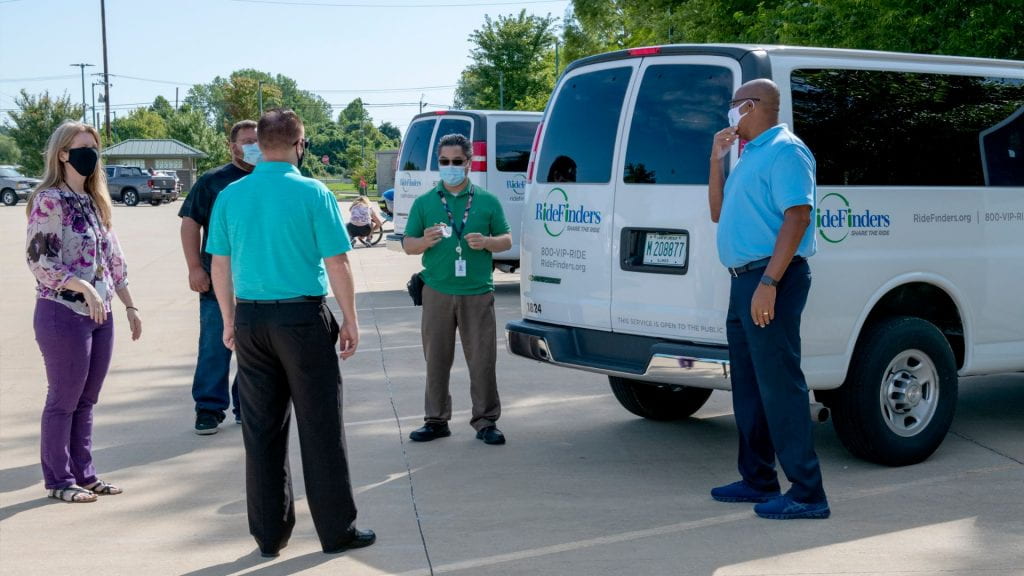
Donna and Gary’s commute is made possible by RideFinders’ vanpool program, which provides a vehicle, maintenance, insurance, and gas, for any group of five or more individuals who want to commute together. Available to all residents of the greater St. Louis area (9 counties across Illinois and Missouri), the goal of this program is to reduce emissions and enhance our regional air quality, while providing an affordable and convenient way for people to commute.
As a long-time vanpool rider, Donna says that there are countless reasons to vanpool, including the convenience of not having to maintain a car, not paying for fuel, as well as being able to use the hour-long commute there and back to take well deserved naps before or after a long workday.
Benefit #1: Save Money
Over their two decades of vanpooling, Donna and Gary have saved thousands of dollars, and this is actually the primary reason that motivated them to start vanpooling in the first place. “The cost of RideFinders is much better than paying for gas, paying for parking, and paying for the wear and tear on your vehicle,” says Donna.
Tina Johnessee, RideFinders Vanpool Outreach Coordinator, is excited to share with us that the monthly Vanpool fares were just restructured and overall lowered, including a further reduced rate for a vanpool of 10 or more riders. The fare chart determines how much each rider has to pay monthly, based on mileage, commute frequency, and overall number of riders in the party. You have guessed it, the more riders in the party; the lower the fare will be for everyone!
And there is more. RideFinders waives the monthly fare for vanpool primary drivers in exchange for driving, fueling, and administering the vanpool. A great deal according to Gary who enjoys driving “while everyone else sleep like babies.” Drivers are also provided with a debit card they can use for gas when needed, so they don’t have to advance any of their own money.
In addition, “the Med School lets us park in their parking lot for free,” says Gary, a perk for people who vanpool, “so we don’t have to pay for that either.”
RideFinders’ Commute Calculator will give you a sense of how much money you can save by switching from driving alone to carpooling, but keep in mind that savings would be even greater if you were to join a vanpool!
Benefit #2: Increase Convenience and Flexibility
Included into the monthly fare are also vouchers for the Guaranteed Ride Home Program. Vanpool riders receive up to four $125 taxi rides per year in case of emergencies, or if they have to work late or leave earlier than the vanpool’s departure time that was agreed upon among riders. “It is really good to have the cab rides home in case something happens during work or to your family,” says Donna, “the cab rides will take you back to where you need to be,” whether it’s your home, your car, or elsewhere.
Other than those exceptional circumstances, however, riding a van to work instead of driving your own vehicle means that you get more hours of free time. In Gary’s words: “Your time, all of a sudden, is your own.”
“We used to have a couple of riders who would study,” adds Donna, referring to the activities that people would do on the van to and from work, “they were going to classes so they would read on the van while they’re on their way home.”
The pick-up and drop-off spots for the vanpools can also be flexible. While the general route for Donna and Gary’s team is from Union to the WUSM campus, passengers can also get dropped off other places along the way by coordinating individually with the primary driver. “We had somebody from the zoo once,” says Donna.“We used to swing through Forest Park and pick him up at a certain spot, then drop him off wherever he needed to be.”
The parking of the vehicle overnight is another flexible variable. While Gary and his team use one of the many commuter parking lots available in the region, participants are also allowed to drive the van all the way to their home for overnight parking, which is especially convenient for those who don’t own a vehicle.
Benefit #3: Make New Friends
In Donna and Gary’s case, seeing familiar faces week after week has allowed passengers to grow friendship with one another. “I knew her kids as babies, that’s just how it is,” says Gary, referring to Donna’s son, Jimmy. “You start to know people for a long time.”
Donna and Gary laughed remembering a time, early on in their vanpool journey, when the team came together to clean the van at Donna’s house. “Jimmy was a newborn when I first started riding the vanpool; we used to put change on the floor so he could ‘clean it up.’”
Having known each other for decades, Gary and Donna’s complicity and trust is palpable. They illustrate the human connections that can flourish from sharing something as mundane as a commute with people you would have never met otherwise.
Benefit #4: Stay Safe
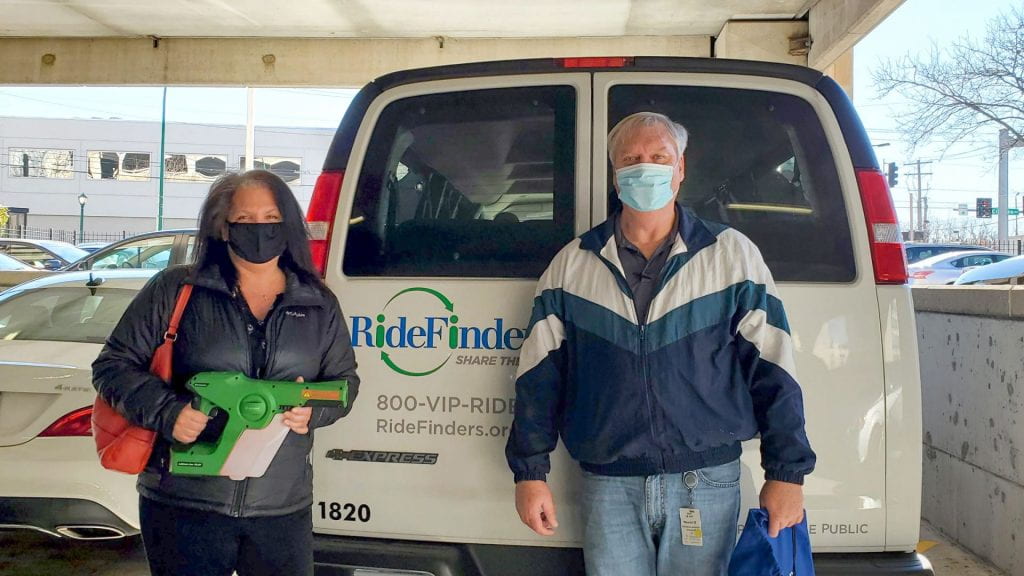
The actual cleaning of the van, of course, does not fall onto the shoulders of a toddler. The vehicles are usually cleaned every six months through an electrostatic cleaner, though since the start of the pandemic, a clean commute commitment was adopted to double down on sanitation practices. Included in this commitment is a mask mandate enforced throughout all the vanpool parties, and an encouragement to lower the vehicle’s windows to increase ventilation. Each vehicle is also stocked with gloves, masks, and sanitizing wipes, ensuring that every surface that is touched can also be wiped down in between each shift and transportation of passengers.
“Regardless of the pandemic, people still have to get to work,” says Tina, who was among the first of the staff to start stocking the vans full of PPE even when there was a shortage in the beginning of the pandemic. “We are here for them. We just want to make sure that the safety of the riders stays at the utmost importance.”
Vanpool Outreach Coordinator, Tina, holding the electrostatic atomizer, visits Gary’s van for sanitation.
Benefit #5: Contribute to a Cleaner Planet
In November 2020, WashU was one of three recipients of RideFinders’ 2020 Regional Sustainability Award. Having added the most participants in the past 18 months into RideFinders’ carpool and vanpooling programs, WashU is celebrated for being a player in reducing single-occupancy vehicles on the road and improving air quality in the St. Louis region.
According to RideFinders, “vanpools remove nearly 800 vehicles and 60,000 driving miles from our region’s roadways daily – easing traffic congestion for everyone.” In addition, “by reducing the number of vehicles on the road, vanpooling helps eliminate over 2 million pounds of air pollution annually – allowing everyone to breathe easier.”
“Saving money is always on the forefront of most of our minds, but I have a new granddaughter,” says Tina. “When I started working here, that was one thing that I wanted to do. I wanted to make sure that I do my part and make this world a better place for her to grow up.”
Thousands of St. Louisans know that public transportation is a convenient, cost-effective and hassle-free way to get around the St. Louis region. It’s particularly viable in the winter months – as transit riders don’t have to worry about heating up personal vehicles, navigating potentially dangerous roadways nor the added expense of gasoline at a time of year when engines are less fuel efficient.
Have you ever given transit a try? Or are you one who has taken MetroLink to a ballgame or concert, but never considered it for the workday commute? If so, Citizens for Modern Transit (CMT) – the region’s transit advocacy organization – has a free, award-winning opportunity known as the Try & Ride program that might be of interest to you.
The program allows commuters to test drive the transit system for the daily work commute. Those who register for the program get personalized route recommendations, complimentary transit fare tickets and a host of tips and tricks for taking transit. The program is a two-month commitment. Complimentary transit tickets are provided for the first month and riders are required to utilize the bus or train for one additional month at their own expense. Another benefit of the program is registration in CMT’s Guaranteed Ride Home Program, which provides access to more immediate transportation options in the case of personal emergency, sickness or unscheduled overtime by way of a taxicab, ride-hailing services like Lyft, or rental vehicle through Enterprise Rent-A-Car. CMT subsidizes the cost of 80 percent of these types of rides, up to $60 per ride, for those eligible.
“Some area residents shy away from taking public transportation because of the fear of the unknown,” stated Kim Cella, executive director of Citizens for Modern Transit. “Our programming is designed to combat this by offering commuters all the tools and resources they need to confidently navigate our region’s integrated public transit system to get where they need to go.”
To learn more the benefits of taking transit, which includes helping to clear the air, or to register for the Try & Ride program today, visit www.cmt-stl.org. For more information on the link between sustainable transportation and our air quality, visit our website, like us on Facebook or follow us on Twitter at @gatewaycleanair.
As a returning participant of the St. Louis Green Cities Challenge in 2020, the City of University City remained committed to sustainable practices and programs that improve the health and quality of life of its community, restore and protect its natural resources and strengthen the economy.
University City is one of the oldest suburbs in the St. Louis metropolitan area and has been a proud participant of the St. Louis Green Cities Challenge for several consecutive years. Known for its rich history dating back to the late 1800’s and named after the community’s proximity to Washington University, U City has become a center of learning and culture, as well as an area of prosperous commercial activity. With the three P’s – People, Planet and Profit – at the core of their sustainability strategy, University City strives to remain environmentally and socially responsible while ensuring they make fiscally responsible decisions to implement various projects and programs.
During the 2020 Challenge, University City persisted with collections and public education during COVID-19 to inform residents of how to properly dispose of paint and other household hazardous waste, in addition to generating awareness for illicit stormwater discharge that would result from such waste. Moreover, the City Council established the Commission of Stormwater Issues to continue the study of this complex subject and provide recommendations for the design and implementation of projects and policies to protect the community from stormwater harm and to promote public health.
Another impressive accomplishment that helped earn the city recognition in the 2020 Challenge was a partnership with the Natural Resources Defense Council and Blackbird Foundation to complete an audit of residential food waste in University City. The results from the audit will help to develop new educational programming on the importance of reducing food waste, which will also positively impact air quality in the region by limiting the amount of waste that winds up in landfills. An additional collaboration with Washington University’s Sustainability Exchange Program also led to long-overdue updates to University City’s Sustainability Strategic Plan, which was originally developed in 2010.
To further reduce environmental impact, University City formed a TreeKeeper volunteer group to focus on native planting and to remove honeysuckle and other invasive species that may pose a threat to air quality. In an effort to promote recycling and reduce paper waste, University City also established a program to eliminate delivery of paycheck stubs in envelopes for city employees by moving to electronic-only delivery and hosted a community paper shredding event, which recycled nearly six tons in total over the course of three hours!
Last but not least, University City continued to participate in the regional Grow Solar St. Louis program in 2020, which promotes education and group purchasing discounts for residential solar power, and the commercial Renew STL Solar program.
For additional information about the ongoing sustainable efforts by University City and how your municipality can get involved in the St. Louis Green Business Challenge/Green Cities Challenge, subscribe to the bi-monthly E-Newsletter or visit stlouisgreenchallenge.com. To learn more about the link between sustainability and air quality, explore our website, like us on Facebook or follow us on Twitter at @gatewaycleanair.
Tis the season for music, lights, Santa and gifts – and in the coming weeks this merriment will also be part of Metro Transit trips. Citizens for Modern Transit (CMT), Metro Transit, St. Clair County Transit District, Bureau of Transit Police, Metro Transit Public Safety, University of Missouri–St. Louis and AARP in St. Louis are teaming up to host “Be Merry on Metro” from Monday, Dec. 6, to Friday, Dec. 24, featuring a host of seasonal surprises at Metro Transit Centers and aboard MetroLink, MetroBus and Metro Call-A-Ride vehicles. With transportation-related emissions being one of the biggest contributors to air pollution, taking public transportation during the holiday season is a great way to reduce harmful auto emissions to help keep the air quality in healthy ranges.
This effort will kick off during the morning commute on Monday, Dec. 6, from 7:00 to 8:30 a.m. During this timeframe, representatives from the partnering organizations will be at select Metro Transit Centers handing out “Be Merry on Metro” branded sock hats – along with candy canes and a calendar showcasing all the fun planned for the month of December.
All “Be Merry on Metro” activities are tied to weekly themes and include Music & Lights from Dec. 6-10; Santa & Surprises from Dec. 11-17; and Opportunities and Appreciations from Dec. 20-24. The events will feature strolling carolers, a “Saturday Morning with Santa” event, special Ten Toe Express guided walking tours, promotion of job opportunities, holiday tunes at Metro Transit Centers and more.
Throughout the month, transit riders should also be on the lookout for “Gift of Transit” gift boxes wrapped in red ribbon randomly placed on MetroBus, MetroLink and Metro Call-A-Ride vehicles. If a transit rider finds a gift box, they can keep it and its contents. There will also be hundreds of gift box cutouts. If a transit rider finds one, all they need to do is look for their gift, which is attached to the back of the “Gift of Transit” cutouts. Transit riders can also participate in the Ugly Sweater contest by taking a photo of themselves wearing an ugly sweater, while traveling on transit, and posting it to social channels using #ToastyOnTransit. Participants will be entered to win a special prize package.
“The ‘Be Merry on Metro’ effort is rooted in the mission of all of our community engagement initiatives,” commented Kimberly Cella, executive director of Citizens for Modern Transit. “It allows us to interact with riders, strengthen relationships and reinforce our collective commitment to a safe, comfortable, customer-focused transit experience – all while spreading a little holiday cheer.”
Bi-State Development CEO Taulby Roach added, “In addition to thanking our riders, ‘Be Merry on Metro’ activities also afford us the opportunity to showcase our appreciation for our transit operators and let people know about the great career opportunities available through Metro Transit.”
For more information about “Be Merry on Metro,” visit www.cmt-stl.org, www.metrostlouis.org or www.scctd.org. Individuals can also follow this effort on social channels using #MerryonMetro. To learn more about the link between sustainable transportation and our air quality, visit our website, like us on Facebook or follow us on Twitter at @gatewaycleanair.
With a commitment to corporate responsibility serving as an expression of Graybar’s core values, the company strives to create a culture where employees feel a true sense of ownership for their results and can share in the success of the company, while also taking steps to make the world a better place. At the company’s corporate headquarters located in St. Louis, Graybar has set its sights on long-term goals that will make the company stronger and healthier for future generations,which also helped them to earn the esteemed title of Challenge Champion in the 2020 St. Louis Green Business Challenge.
During the 2020 Challenge, Graybar worked toward creating a brighter, more sustainable future for the communities in which they live and work as part of their Champion Innovation Project – Sustainability Pivots to Service. Here in St. Louis and at more than a dozen Graybar locations across the nation, company employees contributed $15,462 in cash and food donations to local food banks, which Graybar also matched with a cash donation through its recently launched “Empowering Our Communities” program. This initiative not only helps to feed those who are in need, but also helps to improve air quality by reducing that significant amount of food waste that might have otherwise gone to a landfill and generated harmful CO2 emissions.
Other noteworthy sustainability initiatives spearheaded by Graybar’s Green Team – employees from various departments that conduct research, develop sustainable recommendations and share innovative ideas with the company’s Sustainability Committee – included a Print Release program that requires users to log in to a Print Release-enabled device to print their documents. This reduces the number of documents printed in error, saving both paper and toner. Additionally, machines are defaulted to print and copy double-sided, which further reduces paper waste and benefits air quality in the region.Supply Chain Waste Walks are another way the company helps clients identify opportunities to reduce waste in their own processes and procedures, uncover recycling opportunities and improve energy efficiency.
Additionally, Graybar employees worked remotely from March through August last year, which benefitted the region’s air quality by reducing the number of cars on the roads and helped to reduce the amount of harmful greenhouse gas emissions emitted from motor vehicles. Energy tracking also reported that the company’s St. Louis facilities saved an impressive $73,468.33 in electricity costs by doing so!
Looking to the future, Graybar plans to expand its focus on environmental service projects and continue the work stemming from the company-wide 150th anniversary service initiative.
The Clean Air Partnership is pleased to recognize the efforts of businesses such as Graybar that continue to take action for cleaner air by channeling their time and energy towards practicing sustainability. For additional information on how your company can get involved in the St. Louis Green Business Challenge, subscribe to their weekly E-Newsletter or visit stlouisgreenchallenge.com. To learn more about the link between sustainability and air quality, explore our website, like us on Facebook or follow us on Twitter at @gatewaycleanair.